
Former Hill College students published in international scientific journal
Ashlee Ferguson
Thursday, April 30, 2026 8:35 AM
Academics
Hillsboro, TX
 On April 8, 2024, the second total solar eclipse in seven years commenced over North America. The 2024 path of totality spanned from as far south as Mexico, traveling through Texas, the Midwest and New England, culminating in Canada.
Months before the historic April total solar eclipse, a group of former Hill College students, under the direction of Dean of STEM Dr. Sagar Paudel, had the opportunity to work on a project called the Citizen Continental-America Telescope Eclipse (CATE) 2024.
The Citizen CATE team recruited and trained 36 teams of community participants (citizen scientists) along the path of totality to capture a 60-minute film of the inner and middle solar corona in polarized visible light. The team’s goal was to characterize the physical processes that shape the heating, structure, and evolution of a solar corona by using high-cadence, high-dynamic-range (HDR) polarimetric observations, essentially a specialized imaging technique used primarily in solar astronomy, notably during total solar eclipses, to study the sun’s corona in extreme detail. Understanding this particular area of the sun is said to have the ability to significantly assist scientists in predicting future solar events that can disrupt power grids and communication systems.
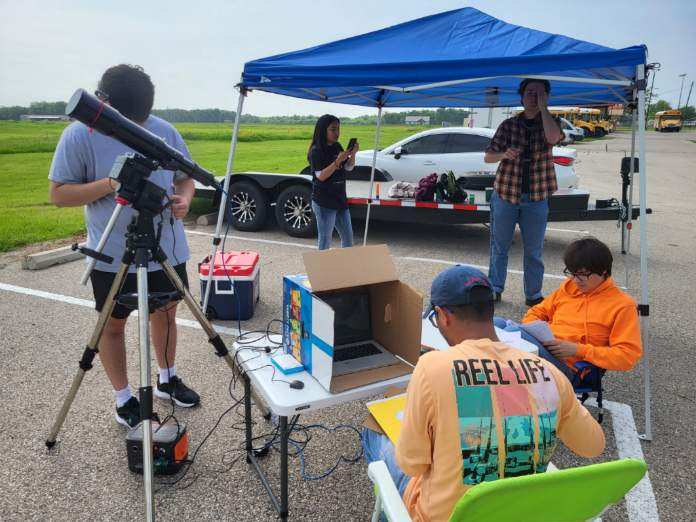
The Hill College team, comprised of former students Nathaniel Cook, Nathan Dodson, and Shekhar Pant, in addition to two students from Texas A&M University, was stationed in Aquilla, Texas, a small town in Hill County.
The team spent nearly two months preparing for the observation. An initial workshop hosted by the CATE team provided students with training to learn the skills necessary to operate the telescope and offered practice sessions for the day of the eclipse. Each of the students learned how to become efficient at setting up, aligning, and using the specialized telescope to fully capture the imaging needed for the project. This included multiple specific instruments that had to be attached to the telescope and properly calibrate to ensure accuracy. In addition, students were also responsible for recording the data.
“This was an extraordinary opportunity for everyone involved. In addition to observing the eclipse, we organized a series of eclipse-themed engagement activities for both students and the broader local community. Our students gained hands-on experience operating the telescope and its data collection, while also developing teamwork, problem-solving, and communication skills alongside their peers,” said Dr. Paudel.
In January of 2026, the Citizen CATE project put together an overview paper, a synopsis of the project, and a preliminary summation of the data recorded. The article, “Citizen CATE 2024: Extending Totality During the 8 April 2024 Total Solar Eclipse with a Distributed Network of Community Participants” was published in Solar Physics, a journal for solar and solar-stellar research and the study of solar-terrestrial physics. A final paper will be published on the scientific of the results of the collaborative research project.
Nathanial Cook is completing his bachelor’s degree at the University of Texas at Dallas (UTD) in biology with a minor in geosciences. He plans to continue his education by earning his doctorate in ecology and evolutionary biology.
“Seeing the solar eclipse, especially with so much background knowledge and enhancing equipment, was one of the most incredible experiences of my life,” said Cook.
Nathan Dodson is currently a student at the University of Texas at Arlington (UTA) where he is working on a dual bachelor’s degree in information systems and accounting, a specialized degree program offered at UTA.
“It was really fun to work with the equipment, particularly in a quiet, rural area. Observing the actual eclipse in that environment was astounding. It was also incredible to see all of the insects and animals nearby and watch their behavior change during the total darkness that occurred during the eclipse as if it were nighttime,” said Dodson.
Shekhar Pant is also working on a dual bachelor’s degree at Texas Tech University pursuing degrees in microbiology and psychological sciences. He is currently doing undergraduate research in stress biology, the impacts of the hypothalamic-pituitary-adrenal axis, and how stress impacts organisms.
“I really appreciated the change during the eclipse and noticed the immediate difference in behavior of the organisms in our observation area,” said Pant.
The college is currently using Citizen Science (a public forum that encourages scientific research and collaboration with professionals and educators to collect and analyze data) projects, in various STEM classes. Students work in groups on a semester-long project and present their research and findings at the completion of the course. Astronomy classes are using citizen science projects from zooniverse.org, while biology major students from Dr. Rukmani Kuppuswami’s class are studying the behavior of fireflies in the Hillsboro area.
“Studies show that course-based undergraduate research projects have a positive impact on students' learning behavior. Our own experience from past years also shows that students learn better when they are involved in the process. Students in those classes were not only more engaged in the classroom, but their understanding and overall performance also showed a huge improvement,” said Dr. Paudel.
For more information about the STEM Pathway at Hill College, visit the STEM link under the Course & Programs tab at hillcollege.edu.